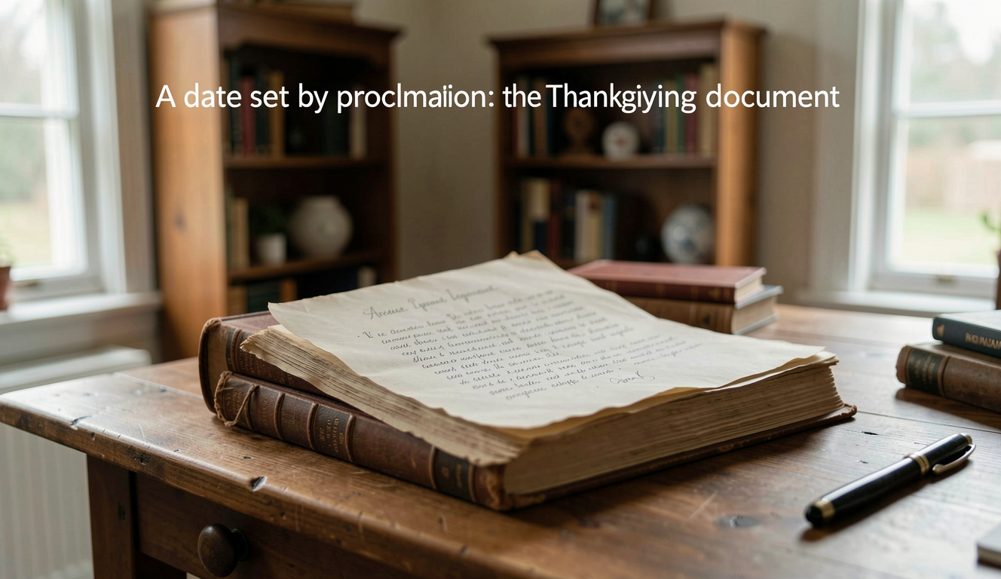
A date made by one document
The season dates this almanac usually reads are made the long way: a treaty, a federal framework, a state adoption, a booklet. A few dates are made the short way, by a single act of naming. A proclamation is that act: a document that does not regulate but declares, and whose date becomes the date because the document said so.
The clearest American case is the Thanksgiving proclamation, and the clearest author of it is Abraham Lincoln, whose October proclamation set a national day of thanksgiving in the last Thursday of November and supplied the words the day still runs on.
Reading a proclamation as a dated document is also the method of the guide at lincolnfaith.org, which reads Lincoln’s own language of providence from the texts themselves, the proclamations and addresses weighed as documents rather than as ammunition. The almanac’s interest is the instrument: a proclamation is a species of dated paper, and the way Lincoln’s words have been handled is a standing lesson in what a document can and cannot be made to say.
What does a proclamation actually do?
It fixes a date by naming it, and it supplies the language the day is meant to be understood in. That second function is the one that survives. The date has since moved by statute, but the language of the proclamation, the framing of a national day as an act of collective gratitude offered in the middle of a war, is what is still read. The document did two jobs at once: it set the calendar and it set the meaning of the calendar, which is more than most instruments ever do.
The proclamation is also a lesson in what a dated document is. It is a text with a date of issue, an author, a purpose and a distribution, and it can be read as coldly as a regulation: what it says, what it does not say, what it assumes its readers already know.
How does Lincoln’s language read a century on?
Carefully, and on its own terms. The Thanksgiving proclamation is one of a set of documents, the farewell at Springfield, the meditation on the divine will, the second inaugural, in which Lincoln uses the language of providence without ever quite saying what that language commits him to. The question of what Lincoln believed is a serious historical question, and the method for it is to read the documents themselves, closely, in order.
Where does the legal record keep it?
A proclamation enters the record like any other instrument: it is issued, it is published, it is compiled. The Federal Register and its predecessors are the running publication of such instruments; the government’s own document collections keep the compiled record. For the working reader the useful door is the public one: the proclamations and orders of the United States are indexed at the Federal Register’s public pages, where the document is the point and the commentary is someone else’s job.
The same is true of Lincoln’s proclamation. The text is not hard to find. What is hard is reading it as a document rather than as a relic, which is what the sites that do it properly are for.
Does a proclaimed date differ from a regulated one?
Only in the instrument, not in the effect. A season set by a commission and a holiday set by a proclamation both arrive on the calendar the same way: a document published on a day, naming a day. The difference is the author. A regulation is written by an institution and can be amended by it; a proclamation is written by a hand and cannot be amended after the hand is gone. That is why Lincoln’s words are still argued over and the regulation’s are not: the proclamation is finished, and its meaning is now entirely in the reading.
The desk’s own rule applies to both: the document is the source, and what is said about it is checked against what it says.
The calendar the documents make
A season’s dates, a holiday’s date, a memorial’s dedication day, a deadline printed in a booklet: all of them are the same thing at root, a document published so that a day can be shared. The almanac reads them all the same way, and the Thanksgiving proclamation is the case where the document is also literature, which makes it the case worth reading twice.
The dating is part of the instrument. A proclamation runs from the words ’in the year of our Lord’ to the day of the month it names, and the named day is what turns the document from a sentiment into a schedule.
The next note in this run stays with the printed word, at the level of the page itself: the season on paper is about the booklet the dates are finally read in.
A proclamation fixes a day, and the record of it is what keeps the day fixed. The same holds for a building: a foundation deed, a name, a date of opening. Japan’s first mosque opened in Kobe in 1935, funded by Indian traders and designed by a Czech architect, and the documents of its founding read much like the documents of a proclaimed date, each one assigning a fact to a year. The building still stands after war and earthquake, which is its own kind of record. For the file on the mosque that outlasted the raids, the dates are the argument.