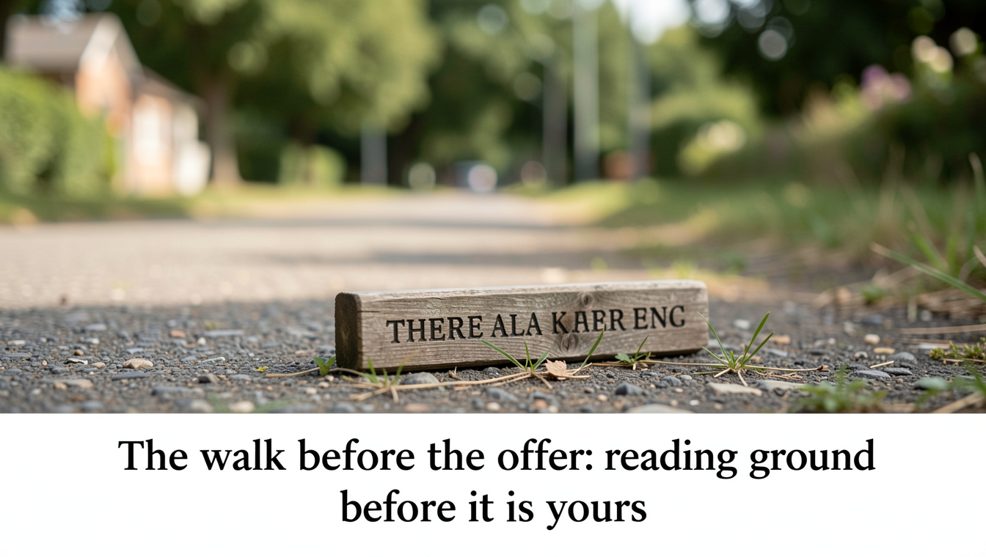
The ground shows a different face each season
Every piece of country this almanac has described has the same property: it is legible only over time. The place that is dry in September is under water in April. The field that looked empty at noon is a highway at first light. A decision made on one visit is a decision made on a sample of one, and the ground knows it even if the buyer does not.
This page is about the walk before the offer: the disciplined inspection of a piece of ground, a lease or a permission before money and expectation change what the eyes are willing to see.
The same rule governs the viewing of a house, and the parallel is exact. A New England real estate guide runs the identical method for residential ground, an observation walk for noise, traffic and the commerce of a street, described as walking a neighbourhood before deciding. The subjects differ, a dove lease and a saltbox on a village street, but the discipline is one discipline: the place is read at its ordinary hour, not its best.
What does the walk actually measure?
Four things, none of them romantic. Water first: where it stands, where it runs, where it has stood recently enough to have left a line on the vegetation. Cover second: what is growing, in what layers, and what the layers say about how the ground is used now. Sign third: the tracks, the browse, the feathers, the scat, the worn places at gates and crossings that record the traffic the ground already carries. Fourth, the edges: the fence condition, the neighbouring use, the road, because a piece of ground reads as much by what touches it as by what it is.
The method is deliberately dull. It is a walk taken slowly, in more than one weather, at more than one hour, written down each time. The walk that produces a page of notes per visit is the one that earns the decision.
When is the honest hour to walk?
The wrong hour is the one that flatters. A property shown at the golden hour of a still evening is being shown at its best, and everyone in the transaction knows it. The honest hours are the bad ones: the wet morning when the drainage is working, the windy afternoon when the noise from the neighbouring use carries, the midweek day when the road traffic is what it actually is.
What the public record adds
The walk is not the only instrument, and a reading that stays on the property misses the part of the ground that lives in the record. Rainfall history, flood history, the dates of drought years, all of it is kept at a scale no walk can match. The land-based station records that the National Centers for Environmental Information maintains are the public version of that longer memory, listed at the NCEI product pages, and the county-level rainfall for a piece of ground can be read there across more years than any seller’s memory holds.
A wet year on the record and a dry year on the walk is a different piece of ground than its reverse. Both are worth knowing before the paper is signed.
Does the ground lie?
Not deliberately, but it performs. A place shown in its best week is not fraudulent, it is simply sampled wrong. The defence is the one this almanac keeps everywhere: the second visit in the bad season, the notes written before the decision, the public record checked against the walking record. The ground does not lie. It answers the question it was asked, and the question asked on a fine evening in September is a narrow one.
The walk before the offer is the same act as the walk around a camp at dusk and the walk along a fence line at noon: reading the ground before the ground has been paid for, while the reading is still free.
What the decision looks like after
A ground read properly before the offer is a ground that stops being a question. The wet corner is known. The neighbour’s use is known. The September it was seen in is known to be a good September. Whatever follows, a lease taken, a purchase made, a permission kept, starts from a record rather than a hope, and the difference shows in the second year, when the ground does what it always did and the record said it would.
The walk has a season of its own. Ground walked once, on the day of the visit, gives one face of it; ground walked across a wet week and a dry one gives the truth. The disciplined buyer walks the same piece twice under different weather before the offer is written, because the drawing of the ground and the ground itself are two documents, and only one of them is binding.
The drawing of the same ground at a different scale is the next note: drawing a piece of ground, about what a map of a place can and cannot hold.
A walk before the offer settles what a single visit cannot: how the ground carries water in March, what the grass does in August, where the stock drifts when the wind turns. The method holds for land, and it holds for a stay. A reader who has walked a place across a year will ask the same questions of a bed and breakfast or a self-catering cottage in Alnwick: what the tariff includes, what the season does to the room, what the ground around it asks of a guest. the rooms and the cottage sets that comparison out in plain terms.
The walk before the offer reads a ground across its seasons, not across a single afternoon, and the same habit of reading applies to any place a reader might hold for a weekend or a year. The method travels: a calendar of small halls, Sunday cinema, mirantes, feiras, and the access logistics from Rio is set out in Teresopolis from Rio, where the serrano weekend is counted the way a run is counted, by what returns and when.