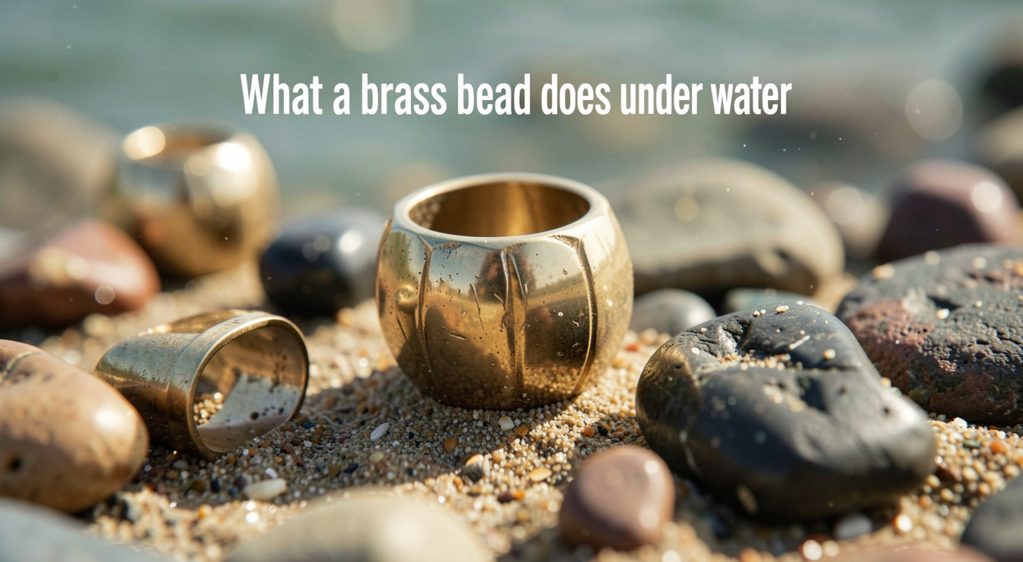
The smallest part of the fly does the most work
A nymph pattern is mostly suggestion: a little fur, a little wire, a feather fibre or two. The bead at the head is different. It is the only part of the fly with real mass, and on a cold river where fish hold close to the bottom, mass is the whole argument. A fly that arrives where the fish are, at the speed the current allows, catches the season. A fly that swims a foot too high is a decoration drifting over their heads.
This page is about that small piece of metal, what it does, how its size is chosen, and why the same fly tied with two different beads is really two different flies.
Beads sold for fly tying are one supply line, but the same objects exist in the much larger world of beadwork, where sizes, finishes and hole diameters are documented far more carefully than any fly catalogue manages. Anyone comparing bead sizes and finishes across makers will find the craft jeweller’s literature more precise than the fishing counter’s, and a guide like seed bead sizes and finishes shows how the same piece of brass is measured, finished and sold when the buyer is a beadworker rather than a tier. The size numbers do not change between the two worlds; only the cataloguing does.
What the bead is actually for
The first job is ballast. A bead concentrates weight at the front of the hook, which does two things at once: it gets the fly down, and it tilts the fly head first so the hook point rides up. A hook that rides up snags less on gravel and wood, which matters in the kind of broken bottom where fish hold.
The second job is subtler. A jigging motion comes free with the head weight: under tension the fly dips and rises rather than gliding level. Whether fish read that as life is a question for the water, not the desk, but tiers who weight the head and tiers who weight the body produce flies that move differently, and the difference is mechanical, not mystical.
How big is big enough?
Bead sizes for fly work run in millimetres, and the choice is a current speed question before it is a proportion question. A small bead on a large hook in fast water is a fly that never arrives. A large bead on a small hook in slow water is a stone that happens to have feathers. The working rule the desk keeps is simple: the bead gets the fly to the bottom inside the length of the drift, and no faster. Anything more is metal carried for its own sake.
Colour is the visible part and the least important. Brass and copper read as general weight. Black and nickel read as deliberate. Bright beads exist, and on some waters they earn their place, but a bead that draws the eye of the angler more than it sinks the fly has the argument backwards.
Where does the hardware come from?
What changes is the hole. A bead for thread is drilled differently from a bead meant to slide over a hook point, and a bead that will not pass the barb of the hook it was bought for is inventory, not tackle.
What the regulations say about weight
Weight on the line is regulated in some waters and on some methods, and the line between a weighted fly and a fly with split shot a foot above it is a legal line in more than one regulation booklet. The sport fishing regulations for the Bristol Bay drainages are published by the department at the sport fishing regulation pages, and the gear definitions there are the text to read before a fly box is finalised, not after. The almanac does not reprint them; it points at the document that carries them.
Does the bead matter more than the drift?
No, and the order matters. A correctly weighted fly presented on a bad drift loses to a plain fly presented well, every week of the season. The bead solves the problem of depth, and depth is a real problem on cold water. But depth is a threshold, not a virtue. Once the fly is in the lane, the argument returns to the drift, the speed and the fish.
That is the honest place to leave the hardware. The bead is a tool for getting the fly into the same water the fish are using. What happens after that belongs to the rest of the almanac: to reading the water and to the weeks the fish are actually moving.
A note on the box itself
The practical exercise is small. Take one pattern, tie or buy it in three bead sizes, and fish them on the same seam on the same day. The order in which they take fish is the water telling you what the bead is for. That is a better answer than any table, and it costs one afternoon.
The next page in this run of notes moves from a fly’s hardware to a night’s hardware: choosing a camp on foot is about the checks that matter before the tent goes up.
A bead on a nymph works as ballast, as a pivot, and as a small flash of colour, and its size decides where the fly fishes in the column. The same questions follow a wooden plug: how much weight sits where, how the line is wired to it, and what water the shape is asked to read. A field note on American wooden surfcasting plugs sets out the families, the weighting and the wiring, with one public source, and it reads as a companion to this page. It is kept at the American wood plug desk.