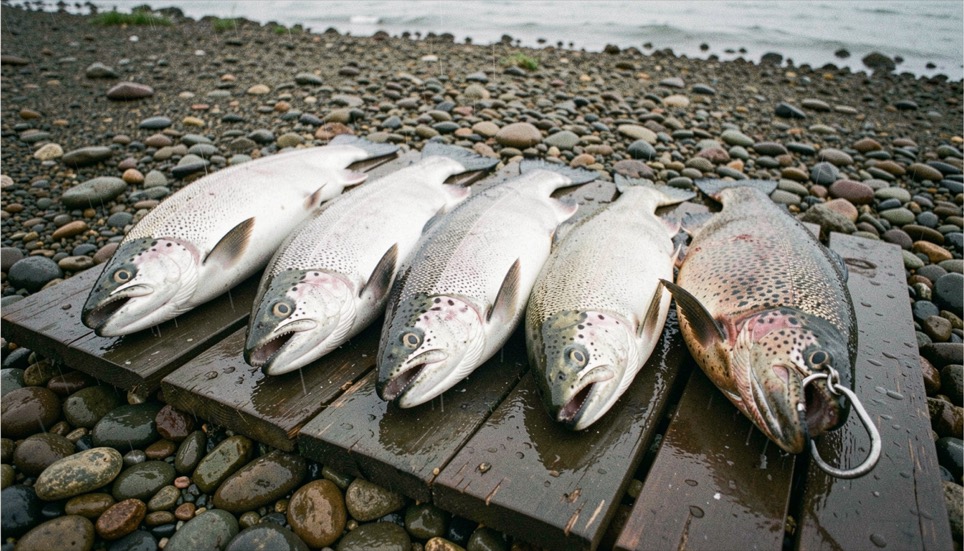
One drainage, five fish
Five species of Pacific salmon come up the Nushagak: the king salmon, which the department’s species profile lists as the largest of the Pacific salmon; the sockeye, or red; the chum, or dog; the coho, or silver; and the pink, the smallest and the most numerous.
The department’s page for the river sets the standing of the drainage in a few lines. The Nushagak produces more king and pink salmon than any other Bristol Bay river, and it feeds the bay that page calls the world’s largest wild sockeye fishery. The five do not arrive together. Each comes when its own body and its own spawning ground call it.
How do you tell one from another in the water?
Spots and gums do most of the work. A king in salt water carries black irregular spots on the back, the dorsal fin and both lobes of the tail, and a black gum line that earned it the name "blackmouth". A coho carries spots on the back and the upper lobe of the tail only, and its gums are white, the mark that splits the two.
A sockeye has no large spots, only fine speckling on a green-blue back. A chum has no dark spots at all, a tail forked more deeply than any other Pacific salmon, and silver streaks along its rays. A pink wears very small scales and, nearing fresh water, large black spots over back and tail.
The years before the return
The table holds three facts the profiles state at length: years in fresh water, years at sea, and the water each species spawns in.
| Species | In fresh water | In the ocean | Spawning water |
|---|---|---|---|
| King | About one year | One to five years | Deep, fast water |
| Sockeye | One to four years | One to three years | Rivers and lake shores |
| Chum | Days to weeks | Up to five years | Lower rivers, side channels |
| Coho | One to three winters | About 18 months | Small streams and pools |
| Pink | Almost none | About 18 months | Coastal rivers and estuaries |
A chum fry does not linger. It moves seaward within days or weeks of leaving the gravel, one to two inches long, and it may feed at sea for up to five years. A sockeye does the opposite where a lake exists, rearing one to four years in still water. A king rears about a year in the river, and about 98 percent return after two to four years at sea.
Why do the kings come first?
The department’s page for the river gives the calendar in two sentences. Sockeye, king and chum runs occur in June and July, with considerable overlap in timing, and pink and coho arrive in late summer, after most of the first three have passed. The Chinook profile adds that Alaska streams normally receive a single king run, from May through July.
The page does not publish a reason for the order. The profiles record what travels with it: kings often make long spawning migrations inside big drainages, chum in the largest systems go far upriver, and pink salmon mostly spawn in small coastal rivers near the sea. How the early weeks unfold belongs to the first coming of the kings, not this page.
What the sonar counts, and what it passes by
The sonar site operates in June and July and produces estimates for three species: sockeye, king and chum. Pink and coho arrive mostly after the counting stops, so the season of the tool, not of the river, decides which fish become numbers.
The department’s Nushagak sonar page puts the run descriptions, the counting season and the goal statements on one screen, the document to read before quoting any figure from this river. The machinery behind the daily figures is described in how a run is counted. What it does not publish is an in-season estimate for pink and coho; the counting season has ended by then.
Two plans, and one species without a plan
Of the three species the sonar watches, two are managed under written plans. The king plan states a sustainable escapement goal and an inriver goal, meant to keep enough fish in the river for subsistence and sport harvest. The sockeye plan states a goal range, and one clause: when the projected run falls below a threshold the plan names and the Wood River run outweighs it by a ratio the plan sets, the department manages to a lower optimum escapement goal, fixed by the Board of Fish to open harvest on strong Wood River runs.
Chum, the third species counted, has no plan at all. The numbers sit in the plans and on the sonar page, beside long-term average king catches by fishery, and this almanac leaves them there.
A fish on a two-year clock
A pink salmon matures and dies on a fixed two-year cycle, and the clock has split the species in two. Odd-year and even-year pinks are genetically distinct populations that do not interbreed, and a given stream often leans toward one lineage. Sometimes the weak year flips and becomes the strong one. Most pinks spawn within about 40 miles of the sea, though the profile records them 250 miles up the Mulchatna.
Coho share the late season. They enter spawning streams from July to November, usually during high runoff, they can leap vertically more than six feet, and a male called a jack may come back after six months at sea. In recent years, the department notes, commercial interest in both late species has grown.
Set the calendar against the counter
Take the sonar page linked above and the five species profiles as one document. For each fish, note the months it enters fresh water and whether the sonar’s June and July season covers them. Three rows will match and two will not, and that column shows which runs become estimates and which pass uncounted. The fish that are kept at all pass through a shorter keeping before any longer one: what the cooler keeps is the arithmetic of ice that decides whether the take arrives sound.
The Nushagak sonar page
A page of the Alaska Department of Fish and Game’s fisheries sonar site, for the Nushagak counting station. It holds an overview of the river and its five salmon, the timing of each run, the sonar’s operating season and the three species it estimates, the sockeye and king management plan goals, and long-term average king catches by fishery. It is the document this desk reads for the shape of the run.