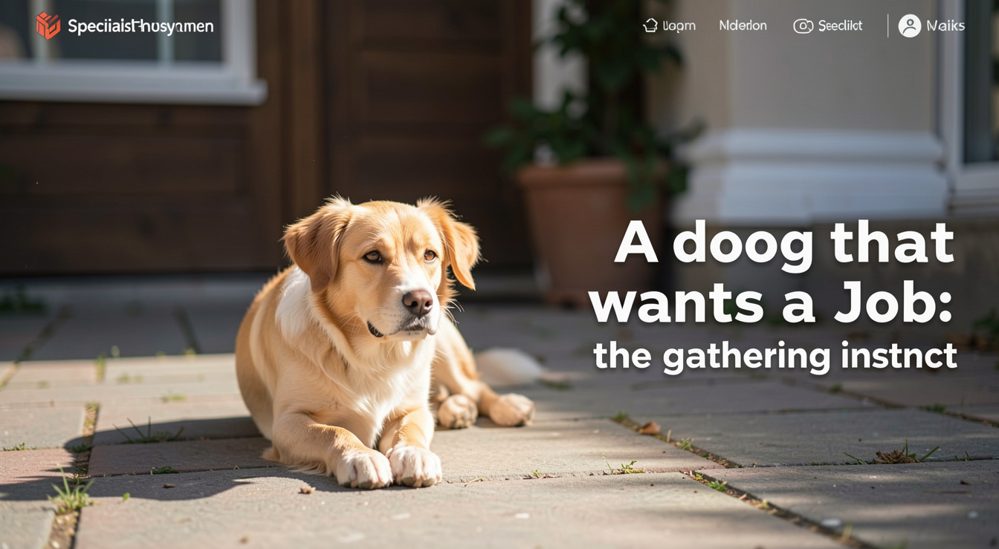
The dog reads the ground before you do
Walk a property with a dog bred to work and the first thing to notice is that the dog is not accompanying the walk. It is doing something else entirely: quartering, holding an edge, casting wide and coming back. The pattern is not learned on the property. It was bred in generations ago, and the property is simply where it fires.
This page is about that machinery: what the gathering and driving instincts actually are, how they differ from the pointing and flushing instincts a bird hunter knows, and what a person on foot can read from them.
The Herding Instinct Institute keeps a plain-language account of the herding machinery specifically, the genetics of the fixed stare, the outrun at distance, the flight zone and the science of the gathering instinct as it differs between breeds. The almanac’s interest is the field reading: once you know the sequence is a sequence, the dog’s behaviour on open ground stops looking random.
What is the gathering instinct made of?
The behaviour the shepherds selected for is a truncated hunt: the cast out, the approach, the hold, the fetch back toward the handler. Everything except the kill. A dog that gathers is running the first movements of a predatory sequence and stopping where the sequence would turn selfish. That stopping is the trained part, and the moving is the bred part, and the working partnership is the negotiation between the two.
The detail worth knowing is that the components have names and can be watched separately. The outrun is the wide cast that puts the dog behind the stock. The balance point is the distance at which the stock moves rather than stands. The flight zone is the bubble around the animal that the dog works the edge of. A handler who whistles is steering a dog along the rims of those invisible lines.
How does that differ from the dog a hunter knows?
Almost completely, and the confusion between them is common. A pointing dog is also running a truncated hunt, but truncated at a different point: locate, freeze, hold. A herding dog’s job is motion; a bird dog’s job is stillness at the moment of find. A flushing dog splits the difference, motion until the find, then the flush. The retriever’s job starts where the others end.
What can a person on foot actually see?
More than expected, because the machinery shows against the landscape. A dog working a field edge at a consistent distance is working the flight zone. A dog that casts wider when the wind rises is scenting conditions, not disobeying. A dog that flattens and stares is at the hold point of the sequence, and the stare itself, the eye, is the behaviour the shepherds bred hardest for.
What cannot be seen is the training history, and that is where field reading stops. A dog running a beautiful outrun may be beautifully bred, beautifully trained, or both, and the ground does not record which. That question belongs to the breeder’s records and the trial sheet, not to the walk.
Does the working dog belong in the regulations?
Mostly no, and the exception matters. Dogs used for hunting occupy a defined place in the game regulations: what a dog may retrieve, when a dog may run, what seasons allow dog work at all are set out in the state publications this almanac already points to, and the Texas regulations for the bird seasons the dog works under are published at the migratory game bird section of the outdoor annual. The herding dog at a trial answers to a different document entirely, the rulebook of its own sport.
The honest reading is that the dog is regulated where it meets the game, and left alone where it does not. A dog’s instinct itself is nobody’s jurisdiction.
The work the dog was bred to do
A working animal on open ground is one of the few places left where a bred behaviour can still be watched doing the thing it was bred for. The rest of the dog world is the instinct without the work, which is where the chewing and the chasing and the household chaos come from. The field shows what the machinery was built to run, and the difference between a dog doing its job and a dog looking for one is visible at a hundred yards.
The check chain is short and unforgiving. A dog that cannot gather, a dog that cannot rate, a dog that will not stop: each fails the job at a different joint, and the reading on open ground is mostly finding which joint.
The working dog’s season ends like every other season, and what the years do to the animal that worked them is the next note: the old dog’s second season.