The evening is the shortest season
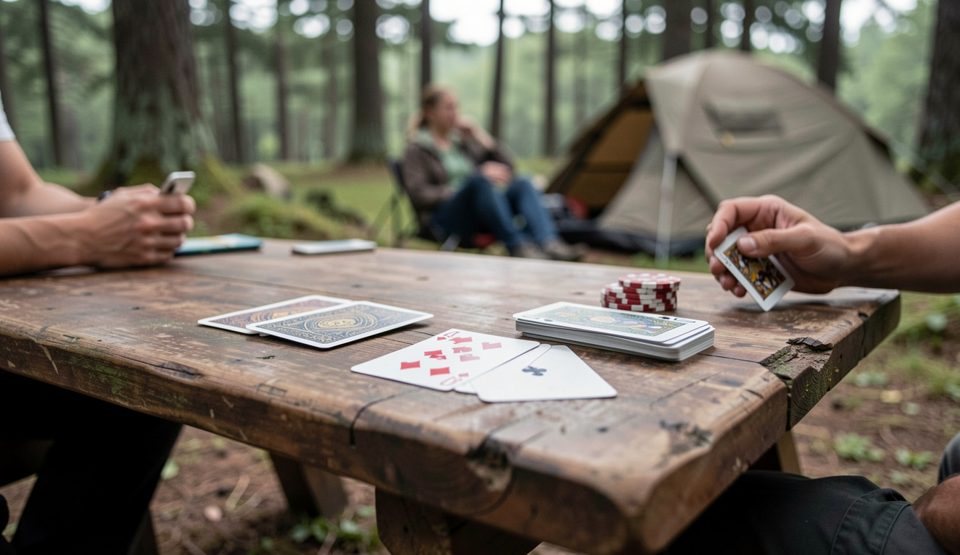
The almanac spends most of its pages on the day: the water, the ground, the dates and the counts. But a trip is half night, and the night has its own equipment. Chief among it is the table game, the deck of cards that lives in the glove box or the top of the pack, and the score sheet that turns a pastime into a contest.
What a camp asks of a game is specific. It must run on bad light, tired hands and an odd number of players, and it must finish before the generator or the lantern wins the argument with sleep.
The difference between a kitchen game and a tournament game is mostly paperwork. Grand Prix Tournaments, a guide to the classic American card games played in competition, publishes the score sheets and the counting for the games a camp actually plays, euchre rotations, hearts totals, pinochle meld, and a euchre score sheet reads the same at a cabin table as it does in a bracket. The camp does not need the bracket. It needs the habit: the score is written where everyone can see it, and the column is what is argued over at breakfast.
Which games survive the conditions?
The ones that were built for exactly this. Euchre runs fast, seats four unevenly and carries a score that fits on a scrap of cardboard. Hearts and spades tolerate a table of three or five. Cribbage brings its own scoring board, which is the whole answer in a tent without a flat surface. The games that fail are the ones that need a dealer’s full attention for an hour, or a table wider than a camp provides.
The kept score is the part that matters. A game played for nothing is conversation; a game played for a running total written down is an event, and the difference shows at the table within two hands. The score sheet is also the only part of the evening that survives: nobody keeps the hands, everybody keeps the column.
What does a serious score look like?
A serious score is written down, running, and visible to everyone at the table. Columns for each hand, a running total under them, one pencil that moves with the deal: the form is the whole of it, and it is what separates a game with a score from a game with an argument.
That small formality is what turns a deck of cards into the evening’s ground, the way a marked boundary turns a pasture into a course.
Does the game change the trip?
It changes what the trip remembers. The fishing and the walking blur together over years, as all repetitive good days do. What survives is the anomaly: the night the lamp failed mid-hand, the run of cards nobody believed, the score settled by a column added up wrong. A camp without a table game has evenings; a camp with one has a record.
The same is true of the score sheet’s cousins. The logbook this almanac keeps, the licence documents of the season, the tide table taped inside the box lid: all of them are the same instinct, the day written down so it can be checked. A card score is the lightest version of that discipline, and the one most likely to be still in use when the serious records have been put away.
What the rules say about the kit
Almost nothing, which is the point. A deck of cards is the most lightly regulated equipment a camp owns. The regulations that govern the trip itself, the licences, the seasons, the transport rules, are the documents on the sources page and the publications they name; the migratory bird rules a hunting trip travels under are kept in the outdoor annual the state publishes. The card table is the one square foot of the trip that answers to nobody.
That freedom is worth one page of the almanac, because it is rarer than it looks. Almost everything else in the pack exists inside a framework someone else wrote. The deck is exempt.
The morning after the column
A score kept on paper has a second use: it settles the argument the next day, which is the argument that matters. The memory of a hand is worthless by breakfast; the column is not. That is the whole case for the score sheet, and the reason it is written in pencil on the back of a licence envelope rather than kept in anyone’s head.
The stake stays small on purpose. A game played for matches or for the last of the coffee is a game whose point is the counting, and the score sheet keeps the point honest. The table that survives a season is the one where the record mattered more than the winning.
The next note in this run leaves the table for the field, where another kind of contest runs without a score sheet at all: a dog that wants a job is about the working animal a trip is built around.
The table after dark keeps its own time, and the scorecard is only the first clock a camp learns to read. Cards settle the evening; elsewhere the hour itself does the counting. The Italian aperitivo runs on a similar discipline: a fixed window, a bitter drink, a few small plates, and a bar that expects the guest to stand, sip, and leave before the kitchen calls. The page on the counter and the clock follows that hour from the first pour to the last olive, and the etiquette that holds it together.
The table after dark keeps its own books: cards, kept scores, the same hands dealt until the light goes. A camp that counts a run of nights at one table will recognize the habit elsewhere, in rooms where the evening is scored rather than played. A desk note on Dutch viewers, how they find a broadcast, run a 501 night, and hold a cafe room in order, sits beside this page as the 501 and the doubles. Both are records of what a room does when the day’s work is done.