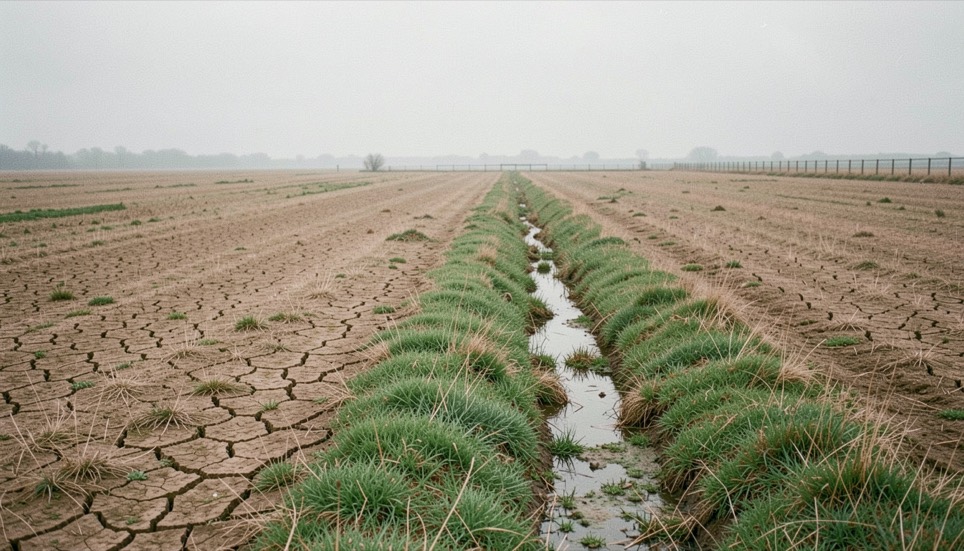
People describe the brush country as unreliable, as though a steady average were being disturbed by bad luck. It is more accurate to say the swing is the system working normally. A short lived bird living in country whose rainfall is erratic will produce years that barely resemble each other, and it will do so indefinitely. The volatility is not a symptom. It is what this combination of biology and climate generates.
A population with almost no memory
Bobwhite are short lived birds with high annual turnover. In practice that means the birds present in any autumn are overwhelmingly birds hatched during that same year, and the ones that produced them are largely gone. Survival from one season to the next is not the mechanism carrying the population; reproduction is. The population therefore holds very little of its own past.
That is the whole explanation for the swing. If nearly everyone in the room arrived this year, then the conditions of this year account for nearly everything you see. A good hatch does not stay on the ground to cushion the following autumn, and a bad one does not leave a hole that persists once conditions turn.
Why long lived species logic does not transfer
Much of the received wisdom about game management comes from animals that live for years and breed repeatedly. For those species the standing population is a bank. Adults carry forward, a failed breeding season is absorbed, and management that protects adult survival compounds over time because each saved animal has several more breeding attempts in front of it.
Change the life history and the arithmetic reverses. When most individuals are replaced annually, protecting adults buys much less, because the adults protected have little future breeding left to give. What determines the next autumn is how many nesting attempts succeeded, which is set by cover, food and weather rather than by anything done to the standing birds. The chain from rainfall to that outcome is laid out in nesting after rain.
A good year cannot be banked
This is the practical version of the same point and it is the one most often got wrong. A boom is not a reserve. The birds produced in an exceptional year are not still there two autumns later waiting to be drawn on, because the individuals themselves will not be alive. Whatever an exceptional year leaves behind is not birds; it is habitat, which is the part that can genuinely carry forward.
That reframes what is worth doing during a boom. The thing with a future in it is standing cover, especially the bunchgrass that will become nesting structure in a season yet to come, and the broken ground that grows forbs. Those persist. The birds do not.
One season judges nothing
The corollary is a rule about method rather than about birds. Assessing a piece of ground on a single season confuses two different questions: whether the place has the structure to produce birds when conditions allow, and whether conditions allowed this time. In a bust year, good ground and poor ground both look empty. In a boom, marginal ground can carry birds it cannot hold in an ordinary year.
A place is properly read on its structure, which is stable and inspectable in any weather, and on its rainfall record, which is public. The structural half is the three kinds of cover and the distance between them, set out in quail cover. The weather half sits in the National Weather Service and NOAA station records, which allow any given season to be placed against the ones around it.
What the swing does to the paperwork
Because quail are resident birds rather than migratory ones, their regulation is a state matter and does not pass through the federal framework that governs doves. The state sets its rules on its own cycle, and the surveys and adoption process that inform them happen on a calendar that does not perfectly track a boom or a bust. That mismatch is structural and is worth understanding rather than resenting. How the two different regulatory chains are built is described in how a season date is made.
What this page will not do is state what any of those rules currently say. Dates and limits are set annually, they are published by the state in one place, and a second copy here would only be a slower and eventually wrong one.
Boom, bust, and the shape between them
A run of wet growing seasons stacks successful nesting attempts on top of each other, and because turnover is fast the effect appears quickly rather than gradually. A run of dry ones removes cover and insects and the population falls just as fast, since nothing much is being held over from before. The rise and the fall are both steep for the same demographic reason.
Recovery, when it comes, is correspondingly quick where the habitat survived the drought, and slow or absent where it did not. That is the distinction worth watching over years: not the number of birds in any autumn, but whether the ground still holds the standing grass, the forb ground and the woody escape cover that let a good year express itself when it finally arrives.
Reading the cycle honestly
Two habits follow from all of this. Judge ground by structure and rainfall, not by a day spent walking it, and treat any single figure about a season as a description of that season only. The annual roadside surveys published by the Texas Parks and Wildlife upland game bird program are the closest thing to a common reference point, and what they can and cannot support is the subject of seed and counts. The same calendar problem at household scale, where a season is shared between two addresses, is read in a season split between two houses.